


 Brief Description of the Practice
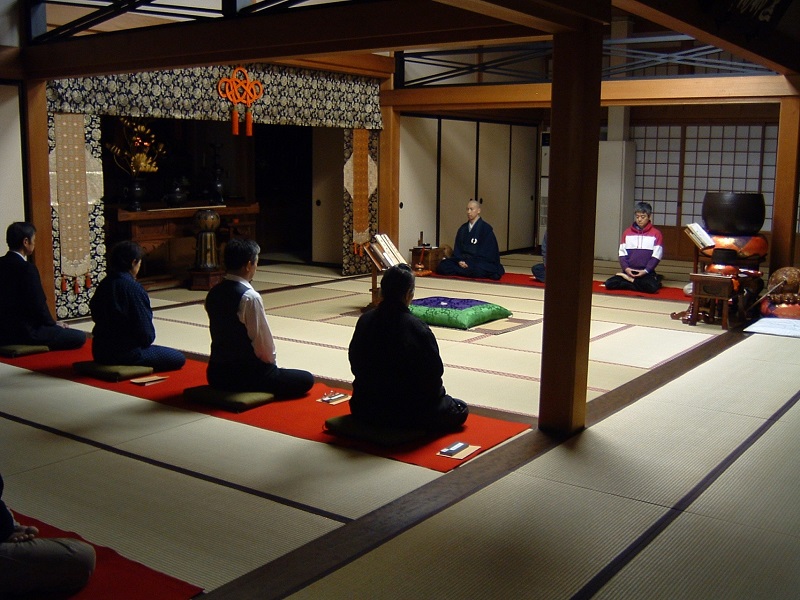
This form of meditation belongs to a Zen practice that developed within the Western tradition associated with the San Francisco Zen Center. Unlike classical wall-facing zazen, practitioners are seated in a large circle, facing the center. This arrangement strengthens collective presence, sharpens awareness of shared silence, and emphasizes the interconnection of practitioners.
The practice includes:
- seated meditation (zazen),
- walking meditation (kinhin),
- a structured system of sound signals given by the jiki.
These sounds are not decorative elements but an integral part of the form. They mark transitions and help sustain the shared field of practice.
The Role of the Jiki and the Zendo Leader
In this form, one person may fulfill two functions:
- Zendo Leader, responsible for guiding the form and time structure.
- Jiki, responsible for maintaining the quality of practice and collective presence.
These roles may be carried by one person, but they are not enacted simultaneously in the same internal mode.
The Zendo Leader manages the form. The Jiki serves the practice.
Switching Between Roles
The Zendo Leader role is active:
- before the session begins,
- when opening and closing zazen,
- when transitioning to and from kinhin,
- whenever changes in form are required.
In this mode, the leader gives signals, maintains sequence, and ensures structural clarity.
The Jiki role is active:
- during seated meditation itself,
- throughout sustained periods of silence,
- between sound signals.
In this mode, the jiki does not control the process but remains a practitioner, maintaining heightened sensitivity to the state of the room.
Sound Signals and Their Sequence
The instruments used are:
- a gong (or bell),
- two wooden clappers.
Beginning of Seated Meditation
- bow,
- one clap,
- four strikes of the bell.
The four strikes serve to establish the space and create a sense of completeness in the form before the meditation fully settles.
Transition to Kinhin
- bow,
- one strike of the bell,
- two claps.
This sequence marks the shift from stillness to movement.
Ending Kinhin and Returning to Sitting
- one clap — signal to stop,
- one bell strike — signal to sit,
- bow,
- three bell strikes.
Closing the Entire Session
- one bell strike,
- two claps,
- turning the cushions.
Pauses Between Strikes
The pause between strikes carries independent importance. What matters is not only the number of sounds but also the space between them. The pause allows the body and mind to settle together and prevents haste.
Walking Meditation (Kinhin)
Kinhin takes place within the same circle. The jiki stands first, setting direction and tempo. Participants follow, maintaining a slow, even pace.
The jiki does not look back or directly correct participants. Alignment arises through attention and shared bodily awareness of rhythm.
When a Round is Necessary
The decision to make a round is not based on time but on felt sense. Indicators may include a loss of collective density, scattered attention, or a weakening of the shared field of practice.
If the impulse to move arises from personal restlessness or fatigue, the jiki remains seated.
Conclusion
This form of practice rests on clarity, minimalism, and respect for shared space. The Zendo Leader establishes structure. The Jiki sustains living presence.
When the form neither distracts nor pressures, practice becomes steady and deep.